Forward Chaining: Reasoning as a Differentiable Layer
PolyWeave's reasoning module turns a propositional knowledge base into a
differentiable forward chainer. You declare facts and Horn-clause rules, and the
chainer repeatedly applies them to a soft truth vector until nothing new is derived —
the deductive closure. Because the premise conjunction is a product (a Pi neuron, the
same multiplicative primitive as fuzzy_and), the whole process is
differentiable in the facts.
On this page:
- Build a knowledge base
- Chain to the closure
- Entailment queries
- Graded truth
- Why differentiable matters
Build a knowledge base
A PropKB holds named facts and rules and(premises) -> conclusion.
Atoms are auto-registered the first time they appear:
from polyweave.reasoning import PropKB, ForwardChainer, print_facts

kb = PropKB()
kb.add_rule(["raining"], "wet_grass")
kb.add_rule(["wet_grass"], "slippery")
kb.add_rule(["raining"], "umbrella")
kb.add_rule(["umbrella"], "prepared")
kb.add_rule(["wet_grass", "sunny"], "rainbow")   # a conjunction
Chain to the closure
Give the chainer an initial truth vector and it iterates to the fixpoint:
chainer = ForwardChainer(kb, max_steps=10)
closure, history = chainer(kb.initial_facts(["raining"]), return_history=True)
print_facts(closure, kb)
print(f"converged in {len(history) - 1} steps")
  [x] raining                1.0000
  [x] wet_grass              1.0000
  [x] slippery               1.0000
  [x] umbrella               1.0000
  [x] prepared               1.0000
  [ ] sunny                  0.0000
  [ ] rainbow                0.0000
converged in 3 steps
From raining alone the chainer derives the whole consequent chain
(wet_grass -> slippery, umbrella -> prepared). rainbow stays false because its
rule also needs sunny, which was never asserted.
polyweave.viz turns the step history into a picture of the propagation:
from polyweave.viz import plot_chaining_trace

plot_chaining_trace(history, kb.fact_names, "chaining_trace")
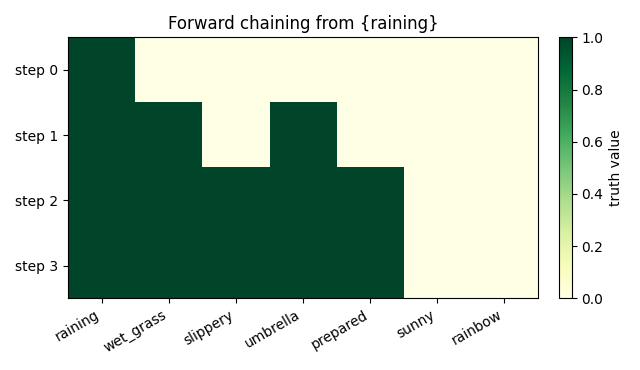
Each row is a chaining step (top = initial facts); a cell turns green as its fact becomes
true. raining fires wet_grass and umbrella, which in turn fire slippery and
prepared; sunny and rainbow stay pale because sunny was never asserted.
Entailment queries
For propositional Horn clauses, forward chaining to the fixpoint is sound and
complete for entailment — so a goal is entailed exactly when its truth crosses the
threshold. The entails helper wraps that:
f0 = kb.initial_facts(["raining"])
chainer.entails(f0, "prepared")   # (True, 1.0)
chainer.entails(f0, "rainbow")    # (False, 0.0)
Graded truth
Truth values are soft, so partial evidence propagates. With the product t-norm, a chain of single-premise rules passes its input through unchanged:
f = kb.initial_facts([])
f[0, kb.idx("raining")] = 0.7
print_facts(chainer(f), kb)        # wet_grass, slippery, umbrella, prepared all = 0.7000
The two t-norms differ on a conjunction. With wet_grass = 0.5 and sunny = 0.6:
f = kb.initial_facts([])
f[0, kb.idx("raining")] = 0.5      # -> wet_grass = 0.5
f[0, kb.idx("sunny")]   = 0.6
ForwardChainer(kb, t_norm="product")(f)[..., kb.idx("rainbow")]   # 0.30  (0.5 * 0.6)
ForwardChainer(kb, t_norm="min")(f)[..., kb.idx("rainbow")]       # 0.50  (min(0.5, 0.6))
product is the smooth, Sigma-Pi-flavoured conjunction (gradient through both
premises); min is crisp Gödel logic.
Why differentiable matters
Because every step is built from products and maxes, gradients flow back through the entire reasoning chain to the input facts:
import torch
f = kb.initial_facts([])
raining = torch.tensor(0.8, requires_grad=True)
f = f.clone(); f[0, kb.idx("raining")] = raining

chainer(f)[..., kb.idx("slippery")].backward()
print(raining.grad.item())         # 1.000
That derivative — how much slippery depends on raining — is computed through the
two-hop proof. The practical consequence: this chainer is a reasoning layer. You can
backpropagate a downstream loss into the facts that feed it, or place it inside a larger
network so that part of the model's computation is explicit, auditable deduction rather
than an opaque MLP. (Rule structure is frozen here; making the rule masks learnable —
soft rule induction — is the natural next step, and the basis for learning logic
programs end-to-end.)