Logic, in Products: Gates, Chaining, and Rule Induction
Most of a neural network is addition — weighted sums of features. But logic is
multiplication: a conjunction A ∧ B is true only when both hold, which is exactly
what a product A · B computes. PolyWeave leans into that correspondence, and it gives
you a small toolkit of differentiable logic built on the same multiplicative
primitive as its Sigma-Pi layers.
This post walks the toolkit from a single gate up to learning interpretable rules — every number below was produced by running the code.
On this page:
- Conjunction is multiplication
- XOR in a single neuron
- Reasoning as a differentiable layer
- Inducing rules — with negation
- What's next
- Try it out yourself
Conjunction is multiplication
polyweave.logic gives you the Boolean operators as differentiable fuzzy gates over
truth values in [0, 1]. With the default product t-norm, a fuzzy AND is literally a
product neuron:
import torch
from polyweave.logic import fuzzy_and, fuzzy_or, fuzzy_xor

a, b = torch.tensor(1.0), torch.tensor(0.0)
fuzzy_and(a, b)   # 0.0   (= a * b)
fuzzy_or(a, b)    # 1.0   (= a + b - a*b)
fuzzy_xor(a, b)   # 1.0   (= a + b - 2*a*b)
They're exact on the Boolean corners and interpolate smoothly between, so you can train
through them. The full set (fuzzy_not/and/or/nand/nor/xor/xnor, plus nn.Module
versions) lives in the logic example.
XOR in a single neuron
XOR is the textbook problem a single linear neuron can't solve. But fuzzy_xor
already hints at the fix: a + b − 2ab is a linear term plus a product — a degree-2
neuron. PolyWeave's PolyLinear (linear + low-rank bilinear) has
exactly that, so one rank-1 unit learns XOR while nn.Linear cannot:
import torch, torch.nn.functional as F
from polyweave import PolyLinear

X = torch.tensor([[0.,0.],[0.,1.],[1.,0.],[1.,1.]])
Y = torch.tensor([[0.],[1.],[1.],[0.]])
# ... train each on the four points ...
PolyLinear(2,1,rank=1):  MSE 0.000   preds [0, 1, 1, 0]   ✓
nn.Linear(2,1):          MSE 0.250   preds [0.5, 0.5, 0.5, 0.5]   ✗ stuck at the mean
One bilinear term is the whole difference. (radbas gives a second, radial-basis route
to the same problem — see the logic example.)
Reasoning as a differentiable layer
Scale conjunction up and you get inference. polyweave.reasoning runs forward
chaining over a propositional knowledge base — repeatedly firing rules (product-AND of
their premises) until the facts reach a fixpoint:
from polyweave.reasoning import PropKB, ForwardChainer

kb = PropKB()
kb.add_rule(["raining"], "wet_grass")
kb.add_rule(["wet_grass"], "slippery")
kb.add_rule(["wet_grass", "sunny"], "rainbow")   # a conjunction

chainer = ForwardChainer(kb)
chainer.entails(kb.initial_facts(["raining"]), "slippery")   # (True, 1.0)
chainer.entails(kb.initial_facts(["raining"]), "rainbow")    # (False, 0.0)  -- needs sunny
Because every step is products and maxes, it's differentiable in the facts — the
derivative of slippery w.r.t. raining, computed through the two-hop proof, is
1.000. So this is a reasoning layer you can embed in a network, not just a solver.
For Horn clauses, chaining to the fixpoint is sound and complete for entailment — details
in the forward-chaining example.
Inducing rules — with negation
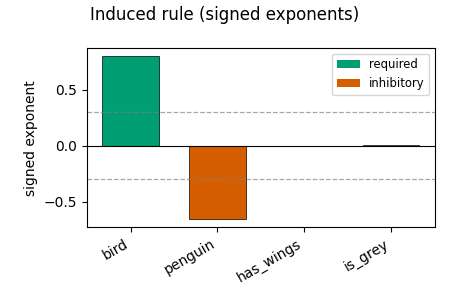
A plain product-AND can only build monotone conjunctions of positive premises. But attach one signed exponent per premise and the product becomes a learnable rule body that the optimiser induces — negation included:
contribution_i = t_i ** [w_i]+ · (1 − t_i) ** [w_i]−
    w_i > 0  →  required     w_i = 0  →  ignored     w_i < 0  →  inhibitory (negated)
SoftSignedLiteral learns "fly ← bird ∧ ¬penguin" and you read the rule straight off the
exponents:
from polyweave.logic import SoftSignedLiteral
# train on  fly = bird AND NOT penguin  ...
feats = ["bird", "penguin", "has_wings", "is_grey"]
layer.literals(feats)
# [('bird', 'required', +0.80), ('penguin', 'inhibitory', -0.65)]   distractors ~0
polyweave.viz turns those exponents into a picture you can read straight off as a rule —
green is a required literal, vermillion an inhibitory (negated) one:
from polyweave.viz import plot_rule_exponents

plot_rule_exponents({"fly = bird & not penguin": dict(zip(feats, layer.w.tolist()))},
                    "rule_exponents")
SoftRuleLayer ORs several of these into a soft DNF. On a 2-rule, non-linearly-separable
target (bird ∧ ¬penguin) ∨ (bat ∧ ¬broken), it recovers both rules — where a linear
model can't represent the disjunction at all:
nn.Linear                0.871     ← can't: DNF isn't linearly separable
soft rule layer (ours)   1.000  (16 params)   rules: "bird & not penguin", "bat & not broken"
MLP (hidden 32)          1.000  (321 params)  ← solves it, but a black box
Same accuracy as the MLP at ~5% of the parameters, and interpretable. The recruitment
diagnostic exponent_abs_mean() (the same one Paper 1/2's layers expose)
reads how much structured rule the layer has recruited.
Honest placement
These are interpretable rule-learning layers in the lineage of Logical Neural Networks and RL-Net/DR-Net — PolyWeave offers them in its geometric-product / recruitment framing rather than claiming a new capability. They're handy, composable building blocks, not a research result.
What's next
The pieces here — gates, radbas, forward chaining, soft-literal rule induction — make
PolyWeave a small differentiable AI-maths toolkit. See Getting
Started to install and the Concepts page for the
multiplicative layers underneath.
Try it out yourself
Run every snippet in your browser, no install required:

Notebook repo coming soon
The companion polyweave-notebooks repo isn't published yet — the badge points at its
intended home. Until then, the snippets run against an editable install (pip install -e .).